 Careers
Students at College can graduate without ever touching a PLC
Walk into a university engineering department and you'll find students learning thermodynamics, circuit theory, fluid mechanics, the syllabus is thorough...

Hannover Messe 2026 runs 20-24 April. 3,000+ exhibitors show industrial automation and AI in Germany, including every major PLC maker.


So why should a maintenance engineer, or the manager responsible for their training, care about a trade fair in Hannover?
Because the technology being shown this week will be on your shop-floor within the next 2 to 3 years. And if your team isn’t ready, that gap between what the equipment demands and what your engineers can do is only going to get wider.
This year, artificial intelligence is the thread running through every exhibition hall. Siemens is demonstrating a flexible production line where an autonomous packing robot and a humanoid robot carry out tasks independently, controlled by AI systems that don’t just recommend actions but take them. Schneider Electric and Microsoft have unveiled an industrial AI copilot designed to eliminate repetitive engineering tasks and speed up troubleshooting. Rockwell Automation has already built a generative AI assistant into its FactoryTalk Design Studio software, allowing controls engineers to use plain language to generate and explain PLC code.
According to a 2026 survey by Redwood Software, 98% of manufacturers are now exploring or considering AI-driven automation (Redwood Software, January 2026). But only 20% say they’re fully prepared to implement it.
That 78% gap? That’s where the skills challenge sits.
It’s not just AI. The PLCs themselves are evolving. Siemens launched the LOGO! 9 in April 2026, the first major update to the LOGO! range in 11 years, with double the function blocks, a colour touch display, and built-in security features. The S7-1200 G1 is being phased out from November 2026, replaced by the new G2 generation, which is not hardware-compatible with its predecessor. That means engineers who’ve spent years working with the G1 will need to retrain.
Mitsubishi Electric has introduced the MELSEC MX Controller, combining sequence and motion control in a single unit with 10 times the motion control performance of previous models. Schneider Electric’s EcoStruxure Automation Expert platform is pushing the industry towards open, software-defined automation where hardware and software from different suppliers can work together.
Every one of these developments changes what a maintenance engineer needs to know.
“Make sure you’re up-to-date with new developments in technology and equipment and the latest versions of PLC software.”
Nathan Ramsahai, Tutor, Scantime
This year’s Hannover Messe is also shining a spotlight on industrial cybersecurity, and for good reason. In April 2026, CISA, the FBI, and the NSA issued a joint advisory warning that Iranian-affiliated hackers had been actively targeting internet-connected Allen-Bradley PLCs across US critical infrastructure, disrupting operations at water treatment plants, energy providers, and manufacturing facilities. A new research paper published in Scientific Reports in April 2026 has documented vulnerabilities in Siemens S7-1200 and S7-1500 PLCs.
Cybersecurity used to be the IT department’s problem. Now it’s an engineering problem. If your maintenance team doesn’t understand the basics of PLC security, network segmentation, and access controls, your shop-floor is exposed. It’s another layer of knowledge that today’s engineers are expected to have.
While the technology accelerates, the workforce that’s supposed to operate it is shrinking. Nearly 20% of UK manufacturing engineers are due to retire by 2026 (ECITB, cited by Michael Page). There are 55,000 long-term unfilled vacancies in UK manufacturing, costing the economy £6 billion in lost output every year (Make UK, April 2025). And 80% of employers struggle to find staff with the right skills (British Institute of Recruiters, 2025/2026).
A PwC outlook published in February 2026 found that manufacturers expect to more than double their use of automation, AI, and advanced technologies by 2030 (Manufacturing Dive, February 2026). Meanwhile, Bain & Company estimates that AI-enabled solutions alone could unlock up to $70 billion in new market value by 2030 (Bain & Company, April 2026).
The question for every manufacturing business is simple: who is going to operate all of this?
If there’s one takeaway from this year’s event, it’s this: the line between “knowing PLCs” and “not knowing PLCs” is a moving target.
Five years ago, being able to get online, read the program, and fault-find was enough to do a solid job as a maintenance engineer. That’s still the foundation, and it always will be. But the definition of “PLC literate” is expanding. Engineers now need to understand new hardware generations, new software environments, AI-assisted tools, and the basics of cybersecurity.
That doesn’t mean every maintenance engineer needs to become a programmer or a data scientist. It means the training your team receives needs to keep pace with the technology they’re working with. It means CPD isn’t optional. It means refresher courses matter, because the software your engineer trained on 2 years ago may already have been updated or replaced.
“Equipment and software versions change. We help you stay current.”
Nathan Ramsahai
If you’re a maintenance or engineering manager, the trends at Hannover Messe 2026 point to 3 things you can act on now.
First, audit your team’s PLC skills against the equipment they’re actually working with. If there’s a mismatch between the software versions on your shop-floor and the training your engineers have had, that’s a risk.
Second, plan for the hardware transitions that are already happening. If you’re running Siemens S7-1200 G1 controllers, your team needs to be ready for the G2 before November 2026. If you’ve got LOGO! 8 modules, the LOGO! 9 is here and the migration path involves new expansion modules and updated software.
Third, invest in training that keeps pace. A one-off course 5 years ago isn’t enough anymore. PLC training is a continuous process, not a single event. Engineers need regular exposure to stay sharp, and they need a safe environment to practice in, away from the pressures of the live shop-floor.
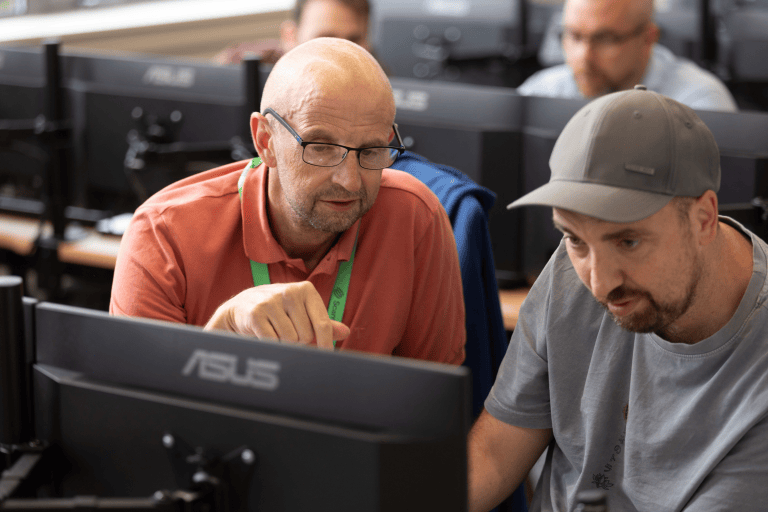
“In one week, you’ll gain a wealth of knowledge. It’s a safe place to play around with the software and have someone show you what’s what instead of watching YouTube videos in your own time that may not be right, or even applicable to your shop-floor.”
Nathan Ramsahai
The technology on display at Hannover Messe 2026 is impressive. But it’s useless without engineers who know how to work with it. Our courses give your team hands-on, practical PLC training delivered by tutors who’ve been on the shop-floor themselves, across Siemens, Allen-Bradley, Mitsubishi, Omron, Schneider, and WAGO PLCs.
Training centres in Gateshead and Alderley Park. Courses run weekly. On-site training also available.
Explore our courses or contact our team to find the right course for you.

Our blog
Tools and strategies modern teams need to help their companies grow.
CareersWalk into a university engineering department and you'll find students learning thermodynamics, circuit theory, fluid mechanics, the syllabus is thorough...
 Learn
LearnBooking PLC training usually means a dim room, endless slides read aloud, and wondering if anyone notices you checking your...

 Industry News
Shop-floor safety has evolved hugely since David Simm's 1968 start. PLCs now protect lives - staying current could save yours...

Find the perfect courses for you and your team.

© 2026 Scantime Group Ltd
