 Learn
Learn10 reasons Scantime PLC tutors don’t just talk the talk
There are plenty of PLC training providers out there. Some of them are good, a few of them are very...

Walk into a university engineering department and you'll find students learning thermodynamics, circuit theory, fluid mechanics, the syllabus is thorough and the exams are rigorous, but ask many graduates whether they've ever programmed a PLC, and the honest answer is no.


It’s not unusual for engineers to leave college never having touched a PLC. Every year, engineering graduates enter industry underprepared for one of its most fundamental realities: nearly every production line, manufacturing process, and industrial automation system is controlled by a PLC.
From Siemens TIA Portal on a food processing line to Allen-Bradley systems at an automotive plant, PLCs are everywhere. And yet, a significant number of engineering students reach graduation day without ever connecting to one, writing a ladder logic program, or fault-finding on a live control system.
The result is a skills gap that shows up fast on the shop-floor. Engineers arrive with strong theoretical foundations but limited practical confidence. Managers inherit teams that need upskilling from day one.
Lecturers are under pressure. Curriculum hours are finite. New technology arrives faster than qualification frameworks can keep up with. And here’s the problem at the heart of it: many academic tutors were never trained on PLCs themselves. They were qualified in electrical and electronic engineering, or similar disciplines, and moved into teaching. But PLCs, and particularly modern platforms like Siemens TIA Portal, require specific, hands-on expertise that a degree in engineering doesn’t automatically deliver.
A tutor who has never fault-found on a live PLC can’t teach a student to do it with confidence. They can share theory. They can explain how a ladder diagram works on a whiteboard. But the moment a student sits down at a programming station with a live Siemens S7-1500 in front of them, textbook knowledge only takes them so far.
This is the gap that myself and Scantime set out to close.
Scantime’s Train the Trainer course was designed and primarliy developed by myself, an electrical and electronic engineer with extensive experience across marine, electronics and microelectronics sectors, as well as a career spanning both industry and academia, who understands the precise point where educational theory and industrial practice fail to meet.
The 4-day, City & Guilds Assured course is built for academic tutors in colleges and universities who need to deliver PLC training to qualification levels 3 and 4. It currently focuses on Siemens TIA Portal, the industry-standard PLC software platform used by manufacturers across the UK and beyond but we are hoping to expand it to further software packages.
Tutors don’t need prior PLC experience to attend. The course starts from the foundations and builds up through programming essentials, advanced control functions, and real-world troubleshooting. By day four, participants leave with the skills, confidence, and a City & Guilds digital credential to deliver structured, relevant, hands-on PLC training to their own students.
“We’re helping academic tutors to deliver PLC training within educational establishments. Preparing engineers for the realities of the shop-floor and complementing what we offer at an industrial level.”
Chris Simm, Managing Director, Scantime
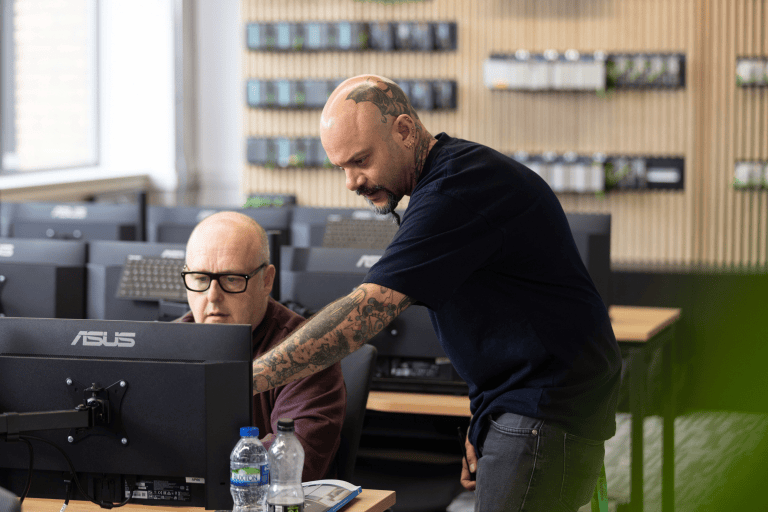
The curriculum is practical throughout. There are no death-by-PowerPoint days. Tutors work on Live PLCs from day one.
Day 1: Getting started with PLCs
Foundations of PLC systems, including CPU architecture, I/O modules, ladder logic, and how to connect to and program a Siemens PLC for the first time.
Day 2: Programming essentials
Timers, counters, real-time monitoring, and live signal checking. Tutors build and test functional programs and complete the day’s practical assessment.
Day 3: Advanced control functions
Flip-flops, shift registers, sequencers, one-shot pulses, and jump functions. The tools that make industrial control logic smarter and more flexible.
Day 4: Real-world integration and troubleshooting
HMI and SCADA integration, sensor inputs, mathematical functions, and structured fault-finding. Final assessments and a debrief that ties everything together.
Scantime was founded in 2004 by David Simm, a time-served controls engineer who started his apprenticeship in 1968. David’s career spans PLCs from their earliest days in UK industry, including work for Procter & Gamble, Nissan, Jaguar Land Rover, Honda, and Toyota USA.
That heritage matters here. The tutors who deliver Train the Trainer aren’t academics who learned from books. They’re engineers who’ve stood on shop-floors, responded to breakdowns, and fault-found live systems under pressure. They know the difference between a theoretical understanding of ladder logic and the confidence to use it when a line has gone down and everyone is waiting.
That’s the difference Scantime brings to the classroom. And it’s the difference tutors take back to their students.
On completion, tutors earn a City & Guilds Assured certificate and a digital credential, internationally recognised and shareable via LinkedIn and professional profiles. The qualification demonstrates that the holder has been trained at a recognised Assured Training Centre and has passed assessments covering the full Siemens TIA Portal curriculum.
For colleges and universities, a tutor with a City & Guilds credential in PLC training is a demonstrable asset. It supports quality assurance, satisfies awarding body requirements, and gives students confidence in the person at the front of the room.
The course is open to anyone who teaches, or plans to teach, PLC training in an educational setting. It suits:
Individuals with no prior PLC experience are very welcome. The course is designed to meet you where you are and bring you up to a level where you can teach it with confidence.
Train the Trainer runs at Scantime’s fully equipped training centres in Gateshead and at Alderley Park, near Manchester. Both sites have dedicated training stations with live PLCs, PLC programming software, and SCADA systems. Every participant receives a customised Scantime workbook to keep as a long-term reference resource.
Courses run regularly at both sites. Demand is high, so booking at least two months in advance is recommended.
Do I need PLC experience to attend the Train the Trainer course?
No. The course is designed for tutors with little or no prior PLC experience, as well as for experienced engineers who want to teach PLC skills in an educational setting. The curriculum builds from the foundations up.
What PLC platform does the course cover?
The Train the Trainer course focuses on Siemens TIA Portal, one of the most widely used PLC platforms in UK industry.
What qualification do I receive?
You’ll earn a City & Guilds Assured certificate and a digital credential on successful completion of all 4 daily assessments.
Can I attend as an individual, rather than through an institution?
Yes. The course is open to individuals as well as institutional bookings. If you’re interested in working with PLCs in an industrial rather than educational context, Scantime’s IMFFP courses are the recommended starting point.
What resources are included?
Each participant has their own training station with a computer, PLC programming software, and a SCADA system. You’ll also receive a detailed Scantime workbook to keep after the course, along with one year of access to the relevant eLearning module.
Explore our Train the Trainer course or get in touch to find out more.

Our blog
Tools and strategies modern teams need to help their companies grow.
LearnThere are plenty of PLC training providers out there. Some of them are good, a few of them are very...
 Careers
Walk into a university engineering department and you'll find students learning thermodynamics, circuit theory, fluid mechanics, the syllabus is thorough...

 Learn
LearnBooking PLC training usually means a dim room, endless slides read aloud, and wondering if anyone notices you checking your...

Find the perfect courses for you and your team.

© 2026 Scantime Group Ltd
