 Learn
Learn10 reasons Scantime PLC tutors don’t just talk the talk
There are plenty of PLC training providers out there. Some of them are good, a few of them are very...

Booking PLC training usually means a dim room, endless slides read aloud, and wondering if anyone notices you checking your phone..

We get it. Most people who walk through our doors on a Monday morning have sat through that kind of training before. The kind where the highlight of the day is the end of the day. This isn’t that. Our courses are built differently, and before you book, there are a few things worth knowing. Some of them might surprise you.
Let’s get this one out of the way first, because it’s usually the biggest concern.
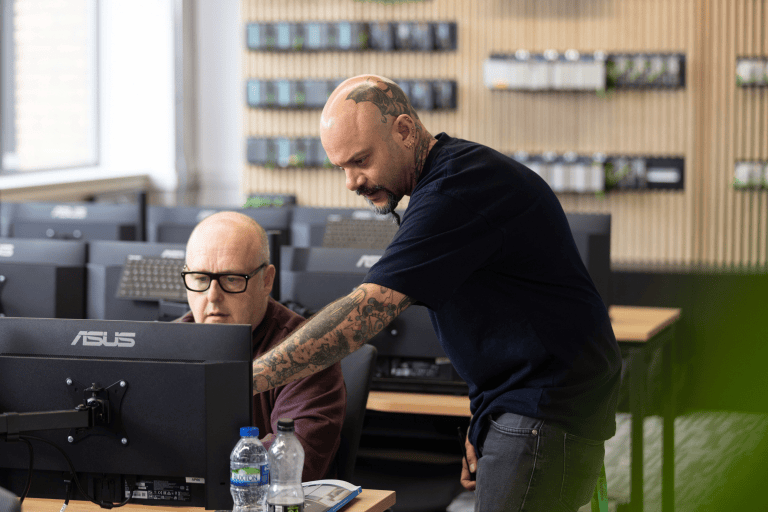
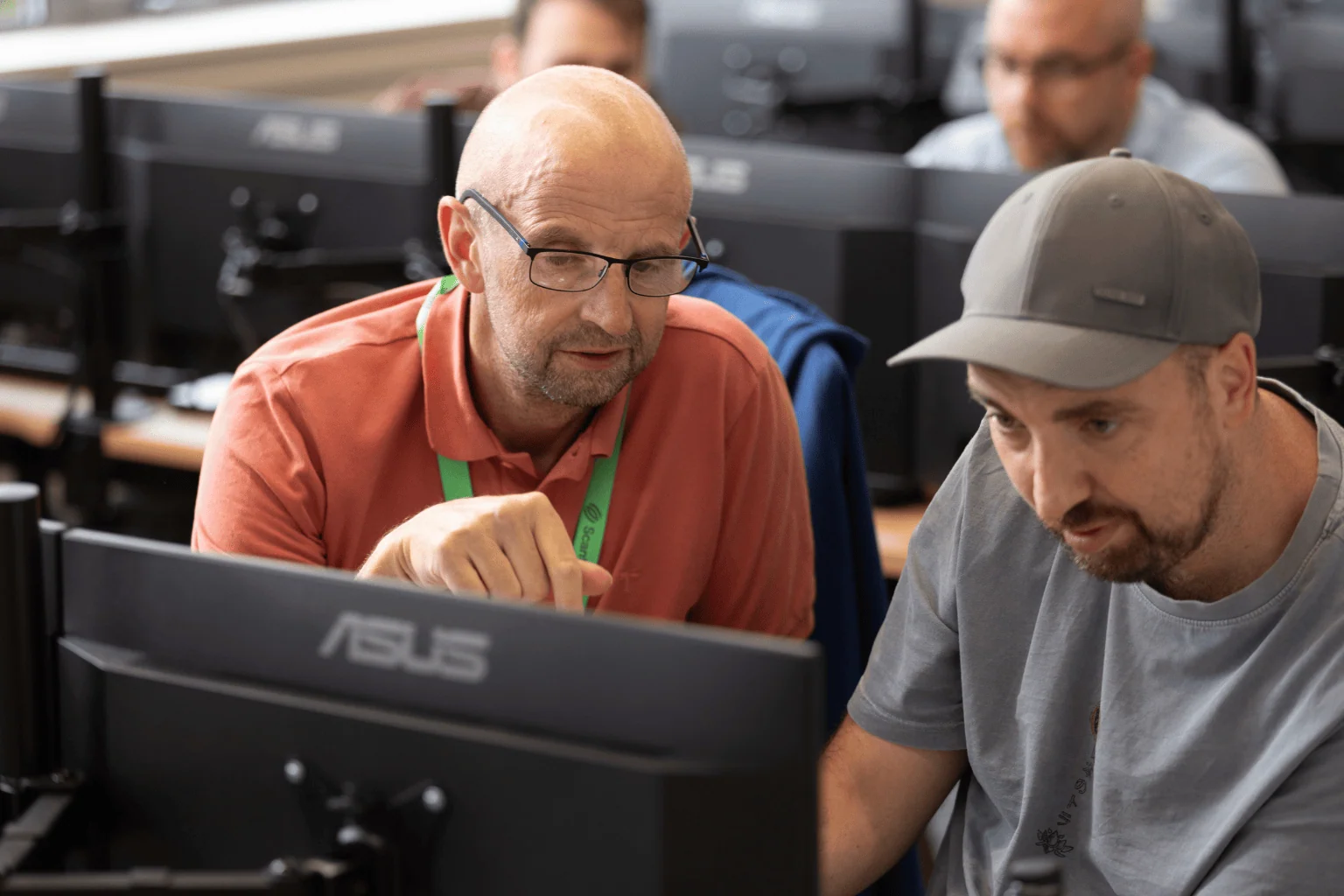
Our slide decks are mainly for our tutors, to ensure we don’t miss anything out. You’ll usually see our tutors park the presentation on a slide highlighting the topic, and then go rogue and teach it their way. Our courses are hands-on from the moment you sit down. You’ll be working on live PLCs, with real PLC programming software, at your own dedicated training station.
That means you’re pressing buttons, navigating programs, making mistakes, and learning by doing. Not watching someone else do it from across the room.
According to a 2024 report by WorkTrek, proper training can prevent up to 12% of equipment failures caused by improper operation and human error. That kind of result doesn’t come from watching slides. It comes from getting your hands on the kit and building the muscle memory you need for the shop-floor.
“We’ll encourage you to test things out and play around. If you break things or shut things down here, it’s okay.”
Nathan Ramsahai, Tutor, Scantime
We work hard not to over-complicate things. The goal is to make sure that what we say is clear, easy to understand, and relevant to what you do every day. If you’re an engineer or technician who’s used to learning on the job, you’ll feel at home here.
You’ve been on those courses. The ones where the chair doesn’t swivel, recline, or tilt. Where it definitely doesn’t have armrests. Where the table’s so light you could push it over with a single finger. Oh and the PC is still running Windows XP and the mouse has a ball in it that stopped rolling properly sometime around 2009.
We’ve all been there. And we decided early on that if we were going to ask engineers and technicians to spend a week learning with us, the environment had to match the quality of the training.
Every touchpoint in our classrooms has been designed with premium in mind. The desks are solid. The chairs are the kind you’d actually want to sit in for a full day. The monitors, PCs, mice, and keyboards are all high-spec, because there’s nothing more frustrating than trying to learn new software on hardware that fights you every step of the way.
There are snack and coffee stations inside the training rooms, so you’re not disappearing down a corridor every time you need a brew. It sounds like a small thing, but when you’re deep into a fault-finding exercise, the last thing you want is to break your concentration because there’s no coffee within 200 metres.
We’ve thought about every detail because we know that the environment you learn in affects how well you learn. If you’re comfortable, well-fed, properly caffeinated, and working on kit that actually works, you’re going to get more out of the week. It’s that simple.
Scantime wasn’t dreamt up in a boardroom. It was built by a man who started his engineering apprenticeship at 15 years old, got his first electric shock at 13, and nearly lost his life at 17.
David Simm, Scantime’s founder and Chair, has been working with PLCs since 1982. But his story goes back further than that. In 1968, he started as an apprentice at Welwyn Electrics in Northumberland, working on high-voltage equipment in an era when health and safety meant a pair of boots on the shop-floor.
Back then, you were expected to work on live equipment. You didn’t turn things off. David’s gaffer would send him to push down thermionic valves inside live enclosures and you could guarantee he’d get a belt. Electric shocks were a daily occurrence. 200 volts, 400 volts. It was just the way things were.
At 17, David had what the old hands used to call “the biggie.” He was sent to fix a high-voltage welding machine on his own. He reached into the enclosure, made contact, and the current locked him in place. He couldn’t let go. He was lucky to survive.
That near-death experience, and others like it, shaped everything about the way Scantime’s courses are designed today. David has spent over 40 years making sure that nobody else has to learn the hard way. Every course is built on practical, real-world experience, not theory pulled from a textbook.
The hexadecimal number system David taught himself in his bedroom back in 1973, writing machine code on a home-built computer? That still forms the foundation of day one on Scantime’s PLC training courses. From hacking into his first PLC on a night shift at Procter & Gamble in 1982, to programming communication systems for the shop-floor at Nissan, to fixing a 24-megawatt power plant in Nigeria that nobody else would touch, David’s career has informed every element of what Scantime delivers.
When we say our courses are designed by engineers, we mean engineers who’ve been there, done it, and have the scorch marks to prove it.
Here’s something you won’t find on the course spec sheet.
We actively encourage our tutors to go off-topic. Not away from the learning objectives, but beyond the standard course content. That means stories. Not just “here’s how a timer block works” but “here’s what happened at 2am on a night shift when the program didn’t work and there were 10 people standing around waiting for answers.”
Our tutors bring real stories from industry, from their own careers, and from their personal lives. It makes the training stick because you remember a good story long after you’ve forgotten a bullet point on a slide. It’s what turns a training course into something that actually feels human.
“Onsite engineers might know how the PLC works but they can struggle to share their knowledge in a way that makes sense to a beginner. Our tutors are experienced engineers and our training rooms are safe spaces where you can practice as you learn and get things wrong, risk-free. There’s no time pressure and no risk of costly downtime.”
Maiken Davidson, Office Manager, Scantime
The difference between a Scantime tutor and someone reading from a manual is that our tutors have lived it. They’ve done the 2am shifts. They’ve driven down the country with parts. They’ve had the stresses and the stories that go with them. And they share those stories because they know it helps you connect with the material in a way that no PowerPoint ever could.
Jay, one of our tutors, puts it simply: he’ll ask everyone in the room on day one what shift pattern they work, what their job involves, and whether they can get online with their PLCs. He wants to know your world so he can make the week relevant to it. That’s not a script. That’s a conversation.
“The training sessions are rich learning environments. People will help each other, offer advice, and share their knowledge.”
Nathan Ramsahai
By the end of the week, you won’t just know more about PLCs. You’ll have heard a few tales that you’ll end up retelling on your own shop-floor. And that’s the point.
On the shop-floor, if you make a mistake with a PLC, the consequences are real. The line goes down. Production stops. People are standing around. Your shift manager’s on your back. The pressure’s on, and it’s not the right time to be figuring things out.
Two-thirds of companies experience unplanned downtime at least once per month, at an average cost of $125,000 per hour, according to ABB’s 2024 Value of Reliability Report. That’s the reality waiting for you back at work.
In our training rooms? None of that applies.
Our classrooms in Gateshead and Alderley Park are set up so you can crash things, shut things down, make mistakes, and try again. There’s no production line depending on you. No one’s losing money. No shift manager breathing down your neck. Just you, a live PLC, and the time to work through problems properly.
“The training room is a safe space where you can practice and get things wrong, risk-free. There’s no time pressure and no chance of losing the money that can be lost on the shop-floor when a line goes down. No one to answer to.”
Maiken Davidson
This matters more than people think. When you’re learning something new, you need the freedom to get it wrong without consequences. That’s how you build confidence. That’s how the skills become second nature. And that’s exactly why we’ve built our training environment the way we have.
“The training room is a safe place. I’ve smashed some stuff in my time, and it sucks!”
Nathan Ramsahai
If you’re the kind of person who learns best by doing, rather than watching, you’re in the right place. Old software, new software, quirks and all. If the unexpected happens (and it usually does), we’ll work through it together. By the time you leave, you’ll have the confidence to try different approaches and find a workaround, because you’ve already done it here.
This is the part that catches people off guard.
Most people arrive on day one not quite sure what to expect. Maybe they’ve been sent by their manager. Maybe they’ve been meaning to book for months. Either way, there’s usually a bit of uncertainty in the room on Monday morning. A few people wondering if they’re going to keep up. A few wondering if they’ll learn anything they don’t already know.
By the end, it’s a different room.
We’ve seen it hundreds of times. Engineers and technicians who arrived feeling unsure about where to start with a PLC, leaving with the skills to get online, fault-find, and get the line away. That’s not a small thing. That’s the difference between dreading the next breakdown and knowing exactly what to do when it happens.
“We’ll give you the skills you need to respond with confidence if your line’s gone down. You’ll be able to get online and access and fix the software, fast.”
Nathan Ramsahai
Even experienced, self-taught engineers pick up new tips and skills from our courses. That’s not just us saying it. We hear it in the feedback, and we hear it from the other people in the room who share their own knowledge and approaches as the week goes on.
And it’s not just about the technical skills. It’s the confidence. Knowing what to do when things go wrong. Knowing how to approach a fault logically instead of guessing. Knowing that you’ve practised it in a safe environment, so when the pressure’s on back at work, you can handle it.
“Save your money tenfold.”
Joe Reynolds, Client Account Manager, Scantime
Whether you’re a fresh apprentice adding PLC training to your skillset, an experienced engineer here to refresh your knowledge, or a technician who’s been thrown into the deep end on a shop-floor full of automated equipment, you’ll leave with more than you came in with. That’s not a promise we take lightly. It’s what 40 years of doing this has taught us to deliver.
We deliver City & Guilds Assured and EAL Recognised courses for Siemens, Allen-Bradley, Mitsubishi, Omron, Schneider, and WAGO PLCs. Our training centres are in Gateshead and Alderley Park. Courses run weekly. Demand is high, so we’d recommend booking at least two months in advance to secure your place.
Whether you’re booking for yourself or your team, we’re here to make sure you get the most out of every day in the training room.
Explore our courses or contact our team to find the right course for you.

Our blog
Tools and strategies modern teams need to help their companies grow.
LearnThere are plenty of PLC training providers out there. Some of them are good, a few of them are very...
 Careers
Walk into a university engineering department and you'll find students learning thermodynamics, circuit theory, fluid mechanics, the syllabus is thorough...

 Learn
LearnBooking PLC training usually means a dim room, endless slides read aloud, and wondering if anyone notices you checking your...

Find the perfect courses for you and your team.

© 2026 Scantime Group Ltd
